High-Bandwidth Espionage: NVIDIA Corporation $NVDA

By Reed R. Kathrein
National Security in the Leather Jacket Era
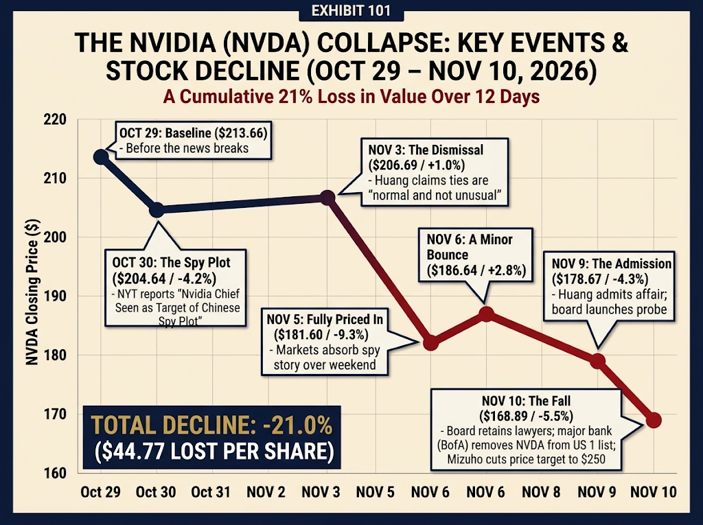
When a multinational tech giant's most sensitive product is restricted by federal export laws, the clock starts ticking on how long it takes for a creative workaround to emerge. Companies are legally allowed to have operational disasters, regulatory hurdles, and even geopolitical headwinds. What they are not allowed to do is lie to shareholders and say everything is fine while their chief executive is allegedly passing the time with a foreign intelligence asset. NVIDIA Corporation (NASDAQ: NVDA) is currently learning that while artificial intelligence can process massive amounts of data, it cannot compute away a federal securities fraud class action.
The Mechanics of the Mirage
The plumbing of the global semiconductor market is supposed to be tightly regulated to prevent advanced AI chips from reaching restricted nations like China. But there is always a middleman. In this case, a Singapore-based data center company called Megaspeed allegedly acted as the conduit, buying chips from the American arm of a Chinese server maker and funneling computing power to Chinese firms. The company made the compliance numbers look good by insisting Megaspeed was just running a small, innocent commercial cloud, fully allowed by U.S. export rules. It is a classic channel-stuffing adjacent maneuver: move the hardware to a friendly jurisdiction, count the revenue, and carefully look the other way when the boxes are left unpacked on the data center floor.
The operational reality, however, involved a much more intimate form of customer relations, according to the complaint filed in Kistenmacher v. NVIDIA Corporation, Case No. 5:26-cv-13448, in the Northern District of California. While NVIDIA assured the public that its compliance team had thoroughly audited Megaspeed and found no evidence of diversion, U.S. intelligence agencies had reportedly already concluded that Megaspeed's executive, Alice Huang, was a Chinese intelligence asset funneling information directly to Beijing.
The Texts
When the initial reports surfaced about the CEO's relationship with this suspected spy, NVIDIA did what corporations always do: they deployed their public relations team to normalize the catastrophe. John Rizzo, an NVIDIA spokesman, offered this remarkable defense of Jensen Huang’s interactions with a foreign intelligence asset:
Jensen's interactions with Ms. Huang are not unusual or unexpected. Meetings with customers are part of a C.E.O.'s job; Jensen talks with thousands of customer executives every year.
There is a timeless corporate mystery as to why PR departments feel compelled to casually write off international espionage as a standard C-suite networking event. The idea that "talking with thousands of customer executives" naturally includes carrying on an affair with a suspected foreign spy working to bypass U.S. export controls is a breathtaking expansion of the chief executive job description. Huang himself later had to apologize to the company, confessing, "I was unfaithful to my wife... There is no excuse for what I did. I am deeply sorry," effectively shattering the illusion that this was just a routine commercial relationship.
The Enforcement Deficit
This is exactly why cases like this land in federal court. The SEC and the Commerce Department are perennially understaffed, underfunded, and drowning in corporate filings. Without private enforcement and the looming Fear Of Lawsuit (FOLS), corporate executives have near-zero economic incentive to tell the truth about their overseas compliance. The regulatory agencies might eventually issue a civil fine a half-decade from now, but FOLS is what actually makes corporate boards sit upright, initiate independent investigations, and correct the pricing of their stock. Class actions aren't a mere annoyance; they are the market’s primary mechanism for enforcing reality when the executive suite decides to treat national security export restrictions as a mere suggestion.
If You Bought the Float
If you happened to purchase $NVDA securities during the period when management claimed their relationship with Megaspeed was a standard, compliant commercial arrangement, and you are interested in seeing the bill for that discrepancy, our litigation team at Hagens Berman is reviewing the paper trail.
- Case Hub: hbsslaw.com/NVDA
- Email: [email protected]