Did you buy a product from an online retailer such as eBay, that also sells the same product on Amazon.com? You may have paid more than you would elsewhere due to Amazon's alleged pricing control. Contact us »
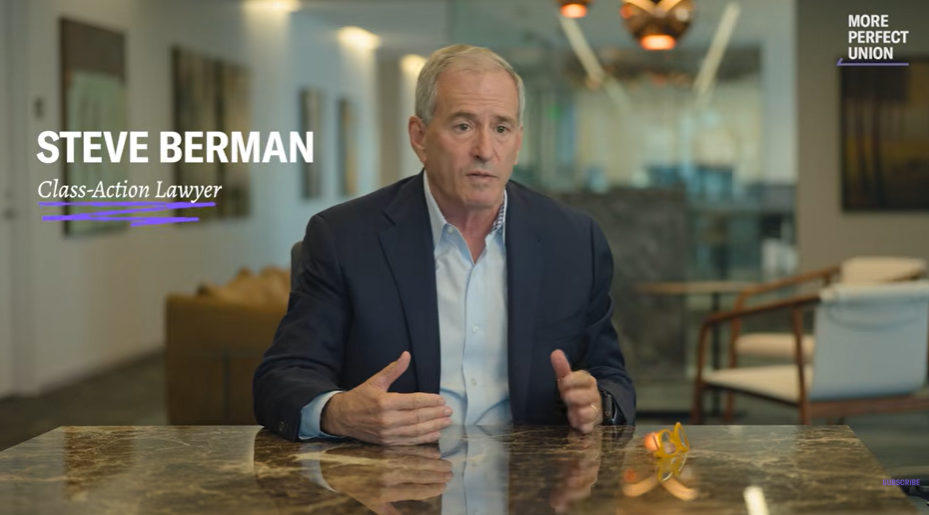
Prices Everywhere," More Perfect Union
An independent investigation by Hagens Berman's legal team indicates that Amazon.com may have violated federal antitrust laws, and attorneys allege that consumers everywhere consequently pay artificially increased prices for products purchased via online retailers across the internet. Consumers have filed a class-action lawsuit against Amazon for allegedly driving up prices for online purchases made from other retailers.
Hagens Berman has also filed a related case representing Amazon customers who have allegedly suffered from paying inflated prices on Amazon’s marketplace due to Amazon’s anticompetitive practices.
Amazon's Alleged Anti-Discounting Policy Blocks Price Competition and Raises Prices on Rival Marketplaces
Amazon operates as a seller, and it opens its marketplace to third-party sellers, so that Amazon can offer its customers an integrated retail site that lists its own retail goods alongside of goods listed by third-party merchants. For a fee, Amazon permits third parties to register with Amazon Marketplace to sell products on Amazon.com to use its platform in tandem with Amazon. This arrangement gives sellers access to millions of buyers and buyers access to millions of sellers via Amazon's controlled platform.
But selling on Amazon comes with certain restrictions. When a seller registers with Amazon Marketplace, it agrees to the terms of the Amazon Services Business Solutions Agreement (BSA) and the policies incorporated in that agreement, which establish rules for setting prices on and off Amazon's platform. Plaintiffs allege that, for decades, Amazon has used those rules to prevent third-party sellers from offering lower prices on Amazon’s rivals’ marketplace platforms — which has harmed competition and forced consumers to pay higher prices.
Until 2019, the BSA contained a “Price Parity Clause” that expressly prohibited third-party sellers from listing goods on other online retail platforms at prices lower than their Amazon prices. Although Amazon abandoned this clause in the EU in 2013 due to antitrust proceedings there, Amazon continued to enforce the clause in the US for six more years.
One way Amazon enforced its price parity requirement is through “Buy Box suppression.” The Amazon Buy Box is a button that allows a customer to add a product with one click to their online shopping cart or immediately proceed to check out with “Buy Now.” When there are multiple offers for a single product, Amazon uses an algorithm to choose one offer to display in the Buy Box. Because virtually all purchases on Amazon are made via the Buy Box, winning the Buy Box is essential for third-party sellers to make sales.
Using its massive online price monitoring system, Amazon tracks billions of off-Amazon prices per year and punishes its third-party sellers — by removing or disqualifying their offer from the Buy Box — if Amazon detects an off-Amazon price that is even one penny lower than the seller’s Amazon price. To avoid the risk of losing the coveted Buy Box, Amazon third-party sellers refuse to offer lower prices on competing marketplaces, even if competitor marketplaces charge lower selling fees. According to the lawsuit, the result is reduced competition among Amazon and other marketplaces and higher prices paid by consumers.
Amazon continues to use its Buy Box suppression tactic today, along with other pricing rules including its “Marketplace Fair Pricing Policy” and the “Amazon’s Standards for Brands,” which similarly prevent third-party sellers from offering lower prices on Amazon’s competitors’ sites. According to the lawsuit, this gives Amazon unprecedented control over pricing beyond its own platform. We believe this violates antitrust laws and harms consumers by setting artificially high prices.
YOUR CONSUMER RIGHTS
The lawsuit seeks reimbursement for the allegedly illegal price increases pushed onto consumers. Hagens Berman believes that those who unknowingly paid high prices for online purchases deserve compensation for Amazon's greed and wrongdoing.
We believe millions of consumers overpaid for online purchases at retail websites that compete with Amazon because Amazon prevents its third-party sellers from competing on price outside the Amazon.com platform. According to the lawsuit, even when it costs sellers less (when the seller sells directly to consumers on its own website or at a lower fee on eBay), sellers are contractually barred or severely penalized from passing on these savings to their customers.
TOP CONSUMER RIGHTS FIRM
Hagens Berman is a nationally renowned plaintiffs’ class-action law firm and has secured more than $345 billion for clients and class members in lawsuits against Big Tech, food corporations, automakers, big banks and others. Hagens Berman has achieved many record-breaking victories in antitrust matters, and your claim will be handled by attorneys experienced in consumer law.
NO COST TO YOU
In no case will any class member ever be asked to pay any out-of-pocket sum. In the event Hagens Berman or any other firm obtains a settlement that provides benefits to class members, the court will decide a reasonable fee to be awarded to the class's legal team.
CASE TIMELINE
On April 13, 2026, Judge Chun of the U.S. District Court for the Western District of Washington denied Amazon’s motion to exclude the expert testimony of Dr. Parag Pathak, who concluded that Amazon’s policies inflated prices across competing online marketplaces. The ruling closely tracks the court’s July 2025 decision in the related De Coster matter, where similar challenges were raised and rejected.
On Aug. 8, 2025, U.S. District Judge John H. Chun of the Western District of Washington granted the plaintiffs’ motion to compel Amazon to produce documents regarding antitrust research performed by economists, scholars and think tanks that were either solicited or funded by the company and are central to its legal defense.
The plaintiffs presented evidence that Amazon had communicated with or funded various authors whose work Dr. Loren Hitt, Amazon’s defense expert, cited. Judge Chun noted that the plaintiffs’ discovery requests are relevant to evaluating the weight and credibility of Dr. Hitt’s testimony.
“The impact of academic research relies on its validity and objectivity,” said Steve W. Berman, managing partner for Hagens Berman and co-lead counsel for the consumer class in De Coster. “If Amazon, one of the world’s largest, most influential companies, has been funding academic research to create favorable outcomes in the court of law, the public and academic community deserve to know.”
The ruling applies to De Coster v. Amazon.com, Inc. (No. 2:21-cv-00693), as well as two other related antitrust lawsuits, Frame-Wilson v. Amazon (No. 2:20-cv-00424) and Brown v. Amazon (No. 2:22-cv-00965).
Read the order »
Read the press release »
On Feb. 20, 2026, consumers moved to certify a class of all persons who, on or after March 19, 2016, purchased at least two Class Products from a third-party seller on the Walmart U.S. online retail marketplace or four Class Products on the eBay U.S. online retail marketplace. Products are “Class Products” if they are new, physical products concurrently offered for sale by Amazon’s third-party sellers on Amazon Marketplace and monitored by Amazon as part of its competitive price monitoring.
On Feb. 3, 2025, Washington federal Judge John H. Chun granted in part of plaintiffs' motion to compel the production of documents from Amazon’s privilege logs in the pending cases Brown et al. v. Amazon.com Inc., De Coster et al. v. Amazon.com, and Frame-Wilson et al. v. Amazon.com Inc. As reported by Law360, Amazon had initially provided plaintiffs with privilege logs which included over 132,000 claims of privilege. But after a re-review, Amazon "downgraded" at least 61,000 of those privilege claims. Plaintiffs allege that the underlying problem was that Amazon appeared to have a policy to instruct employees to falsely mark documents as privileged and then those documents got withheld in litigation. Judge Chun ordered Amazon to complete its review of all withheld documents and produce any that cannot clearly demonstrate that the primary purpose of the communication was to seek or provide legal advice, by Feb. 25, 2025.
In a sealed order on Nov. 19, 2024, U.S. District Judge John H. Chun denied Amazon’s motion to dismiss the Frame-Wilson et al. v. Amazon.com Inc. and De Coster et al. v. Amazon.com Inc. lawsuits. This denial allows plaintiffs to continue the fight against the world’s leading online retailer after three failed attempts by Amazon to dismiss the case.
Attorneys will now move forward with proposing redactions to the court by Dec. 2, 2024. Once the order has been unsealed, the document will be accessible here. Please check back for updates.
District Court Judge Ricardo S. Martinez sided with plaintiffs and ordered Amazon to produce more than a decade of sales data from Germany and the U.K., including historical transactions, sales revenues, shipping charges, commissions and more. The judge’s order dismisses Amazon’s objection that the request was unduly burdensome and not proportionate to the needs of the case. “The production of the requested information will doubtlessly take a significant effort and cost a substantial amount of time and money. But this is a significant, substantial case,” Judge Martinez said.
While the class definition in this case encompasses only U.S. Amazon customers, Judge Martinez wrote that plaintiffs make a “credible and meritorious argument” that U.K. and German sales data is highly relevant to resolving issues in the case.
In dual orders issued by Honorable Richard A. Jones, the court allowed claims against Amazon to continue and appointed Hagens Berman Interim Co-Lead Counsel, jointly leading the case with one other law firm. Judge Jones cited the firms’ work identifying or investigating potential claims, experience in handling class actions and resources available to represent the class, among other skills.
In his order responding to Amazon’s motion to dismiss the case, Judge Jones upheld claims related to Amazon’s monopolization of the market, as well as claims related to its market power and anticompetitive effects.
“Plaintiffs argue, the SAC [Second Amended Complaint] plausibly alleges a ‘naked restriction on price or output, such as an agreement not to compete in terms of price,’ and this is sufficient,” the order reads.
A class certification briefing schedule is due to the court within the next month.
California attorney general, Rob Bonta, has filed a similar case against Amazon, repeating claims brought by Hagens Berman in its most recent antitrust cases against Amazon. In the state AG’s Sept. 14, 2022 filing, Bonta highlights Amazon’s agreements that thwart competition by agreement with its third-party sellers and by agreement with its suppliers. Since March of 2020, Hagens Berman has trailblazed antitrust cases against Amazon related to consumer price-fixing and monopoly claims: De Coster v. Amazon.com, Inc.; Brown v. Amazon.com, Inc; and Frame-Wilson v. Amazon.com, Inc.
Steve Berman, managing partner of Hagens Berman and attorney for consumers in the four class actions related to the AG’s case, said of the new filing, “We are pleased to see California’s attorney general has joined the fight we started in 2020 over Amazon’s unlawful tactics that have greatly harmed consumers. The proposed class actions we filed paved the way for additional antitrust actions against Amazon, and we believe consumers will reap the rewards of this collective action.”
In an order filed Aug. 2, 2022, Hon. Richard A. Jones for the U.S. District Court for the Western District of Washington in Seattle sided with plaintiffs regarding two motions. Judge Jones denied as moot Amazon’s motion to clarify or reconsider portions of the court’s Mar. 11, 2022 order denying in part Amazon’s motion to dismiss, and granted plaintiff’s motion to compel 26(f) conference.
In denying Amazon’s motion, Judge Jones held that direct purchasers (consumers) have antitrust standing to sue Amazon under the Sherman Act. In granting the proposed consumer class’s motion to compel the start of discovery (i.e., gathering evidence), the court ordered Amazon to participate in a discovery conference, following its inaction and refusal to schedule the conference.
Amazon now must participate in a discovery conference within 10 days to “consider the nature and basis of their claims and defenses and possibilities for promptly settling or resolving the case,” make required disclosures, discuss the preservation of discoverable information and “develop a proposed discovery plan” under Rule 26(f).
On Mar. 11, 2022, the court denied Amazon’s motion to dismiss plaintiffs' federal monopoly claims, as well as one of two federal price-fixing claims plaintiffs asserted.
The remaining claims require plaintiffs to prove Amazon's conduct had a significant anticompetitive impact in the relevant market. The court accepted that the U.S. e-commerce market could be a tenable market in which to evaluate the impact of Amazon's conduct, or at a minimum the product categories that Amazon dominates in could be tenable submarkets for purposes of determining Amazon's liability.
The court did dismiss the federal claim that Amazon engaged in a per se price-fixing violation as well as plaintiffs' state law claims, but it allowed plaintiffs 30 days to amend their complaint to address the deficiencies of these claims.
Washington, D.C. attorney general, Karl Racine, today filed a similar case against Amazon, repeating claims brought by Hagens Berman in 2020.
Steve Berman, managing partner of Hagens Berman and attorney for consumers in the class action said of the new filing, “We are pleased to see D.C.’s attorney general has joined the fight we started in April 2020 over Amazon’s unlawful tactics that have greatly harmed consumers. The proposed class action we filed in 2020 has paved the way for additional antitrust actions against Amazon, and we believe consumers will see the benefit of that.”