On Sept. 9, 2026, U.S. District Court Judge Michael H. Simon issued an order granting preliminary approval of a $6.2 million class-action settlement with Madison Ranches Inc. According to the order, the court expects to grant final approval following the fairness hearing to be held March 22, 2027. The 17-page order also provides for notice and instructions regarding objections and opting out.
The order defines the settlement class as all persons who own, rent or reside at property that is supplied with water by a private well that is located in the Lower Umatilla Basin Groundwater Management Area.
The court also provisionally appointed Hagens Berman and co-counsel as class counsel.
The firm continues to litigate claims on behalf of residents against remaining defendants.
Do you live in Morrow or Umatilla County, Oregon and rely on either a public water system or residential wells for your drinking water? Commercial farms, confined animal feeding operations and the Port of Morrow have contaminated your water supply. Fill out the form for more information »
WHAT'S THE ISSUE?
Hagens Berman and its co-counsel, Bliven Law Firm and Heenan & Cook, filed a class-action lawsuit representing those living in Morrow or Umatilla County, Oregon accusing the Port of Morrow, commercial farms and confined animal feeding operations of contaminating groundwater by dumping nitrogen in Oregon’s Lower Umatilla Basin. Attorneys estimate the issue affects upwards of 46,000 residents, many of whom are children. Nitrogen in excess converts to nitrates in the soil, potentially leading to serious health problems.
HOW DO I KNOW IF I'M AFFECTED?
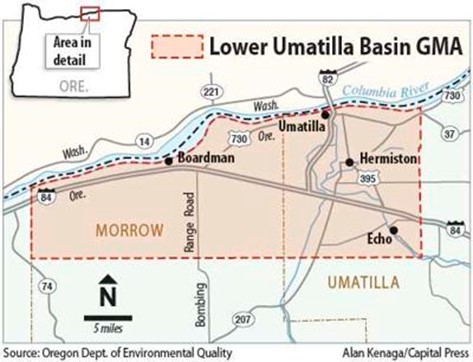
Those who rent, own or reside in Morrow or Umatilla County who rely on either a public water system or residential wells for their drinking water are allegedly affected. Attorneys estimate the affected zone encompasses approximately 562 square miles of land in northern Morrow and Umatilla counties. At least 450 residential wells in the GMA have been tested and found to exceed federal standards for safe nitrate levels. If you live in one of the following cities, you may be affected:
- Boardman
- Echo
- Hermiston
- Irrigon
- Stanfield
Attorneys say more than 45,000 people, including more than 10,000 children, live within the bounds of the Umatilla GMA, and they may be drinking nitrate-contaminated water that could sicken or kill them.
OREGON GROUNDWATER CONTAMINATION EXPLAINED
The lawsuit alleges defendants routinely over-apply commercial fertilizer, animal manure or nitrogen-rich industrial wastewater to fields, and/or allow contaminated wastewater to leach from storage receptacles. It also alleges that defendants who are operating under permits issued by the Oregon Department of Environmental Quality (DEQ) have repeatedly and intentionally violated their permits. For example, the Port of Morrow has been fined for permit violations by the DEQ multiple times, according to attorneys, but it continues to dump more nitrogen-heavy water than its permit allows. Between Nov. 1, 2023, and Jan. 11, 2024, alone, the Port violated its permit at least 395 times, the lawsuit states.
Upon testing his well for nitrate contamination, one of the lawsuit’s named plaintiffs found nitrate levels of 46.8 mg/L, over four times the safe limit of 10 mg/L established by EPA, and more than six times the Oregon GMA trigger threshold of 7 mg/L.
Oregon DEQ says 95% of the nitrate pollution in the affected area is attributable to industrial wastewater treatment and disposal, irrigated agriculture and concentrated animal feeding operations.
THE CONSEQUENCES OF NITRATE POLLUTION
Attorneys say the Port of Morrow, commercial farms, and CAFOs have allegedly contributed to “soaring” levels of nitrates in local groundwater. Excess nitrogen converts to nitrates in the soil. Nitrates are harmful at high levels, especially to infants and pregnant women. Excessive nitrates in water can cause serious health problems including:
- Cancer
- Thyroid dysfunction
- Miscarriages
- Methemoglobinemia, a potentially fatal condition that interferes with infants’ blood oxygen levels
YOUR RIGHTS AGAINST HARMFUL POLLUTANTS
The lawsuit seeks relief under the Resource Conservation and Recovery Act to compel the Port of Morrow, commercial farms and CAFOs to conduct assessment and remediation activities necessary to abate the contamination created by their alleged excess wastewater dumping and/or over-application of fertilizer. The lawsuit also brings claims for negligence, trespass, public and private nuisance, and inverse condemnation.
Attorneys seek injunctive relief that would force defendants to end their alleged contaminating practices, compensatory damages for those affected, and the creation of a medical monitoring program to assist affected communities in diagnosing and treating illnesses caused by exposure to excessive nitrates.
HOW CAN A CLASS-ACTION LAWSUIT HELP?
Through a class-action lawsuit, individual private citizens can collectively bring claims against those who would otherwise ignore the complaints of individual citizens. A class-action lawsuit seeks to level the playing field, bringing strength to collective action to change harmful practices. If you are a member of the class, you will be covered by the class action should the court approve it as such, but if you wish to help, please contact us.
CASE TIMELINE
On Sept. 9, 2026, U.S. District Court Judge Michael H. Simon issued an order granting preliminary approval of a $6.2 million class-action settlement with Madison Ranches Inc. According to the order, the court expects to grant final approval following the fairness hearing to be held March 22, 2027. The 17-page order also provides for notice and instructions regarding objections and opting out.
The order defines the settlement class as all persons who own, rent or reside at property that is supplied with water by a private well that is located in the Lower Umatilla Basin Groundwater Management Area.
The court also provisionally appointed Hagens Berman and co-counsel as class counsel.
The firm continues to litigate claims on behalf of residents against remaining defendants.
Madison Ranches Inc. reached a $6.2 million settlement agreement resolving legal claims relating to groundwater in Oregon’s Lower Umatilla Basin Groundwater Management Area (LUBGWMA). Today’s agreement follows a preliminarily approved $20.5 million settlement with Amazon Data Services Inc., bringing the total settlements in the matter to $26.7 million. The firm continues to litigate claims on behalf of residents against remaining defendants.
A federal judge granted preliminary approval to a $20.5 million settlement with Amazon Data Services Inc. in a lawsuit accusing it and other defendants of contaminating the groundwater in Oregon’s Lower Umatilla Basin Groundwater Management Area (LUBGWMA).
On June 5, 2026, U.S. District Judge Michael H. Simon of the District of Oregon denied motions to dismiss a class-action lawsuit against the Port of Morrow, commercial farms and confined animal feeding operations over nitrate contamination of groundwater in Oregon's Lower Umatilla Basin. The ruling allows claims under federal and Oregon state law to proceed against defendants, including Port of Morrow, Lamb Weston, Portland General Electric, Columbia River Processing, Madison Ranches and Threemile Canyon Farms, with a jury trial scheduled for September 2027. The suit alleges industrial wastewater and agricultural runoff have rendered drinking water unsafe for thousands of the region's roughly 45,000 residents, who have been forced to rely on bottled water.
"This ruling is a critical step toward justice for the thousands of Lower Umatilla Basin residents who have lived with contaminated drinking water for far too long," said Steve Berman, managing partner and co-founder of Hagens Berman. "We are pleased the court has cleared the path to trial."
Hagens Berman and its co-counsel, Bliven Law Firm and Heenan & Cook, today announced a $20.5 million settlement with Amazon Data Services Inc. over allegations that ADS’s data center operations contributed to nitrate contamination affecting Morrow and Umatilla counties, associated with significant health and environmental concerns for thousands of residents. ADS denies these allegations.
A motion for preliminary approval of the settlement was filed March 31, 2026, in the U.S. District Court for the District of Oregon, Pendleton Division. Settlement funds will support private well and public infrastructure projects in the LUBGWMA (Lower Umatilla Basin Groundwater Management Area), improving access to clean water for property owners, renters and the broader community.
On Jan. 16, 2026, plaintiffs filed a second amended complaint against a consolidated group of defendants named in earlier filings.
The complaint alleges the defendants conspired to engage in commercial or agricultural practices that polluted groundwater through the land application of high-nitrogen or high-nitrate waste. According to the filing, the defendants were aware of the harmful effects of those practices on groundwater but continued their conduct. Evidence shows the defendants’ operations, individually and collectively, contaminated groundwater in Morrow and Umatilla counties.
The second amended complaint also includes updated data and first-hand accounts from area residents who report being affected by the alleged groundwater contamination.
On Dec. 19, 2025, U.S. District Judge Michael H. Simon issued a 50-page opinion and order partially denying defendants’ motions to dismiss federal and state-law claims against multiple entities responsible for allegedly contaminating water in the Lower Umatilla Basin Groundwater Management Area with nitrates. The order allows claims to procced against the Port of Morrow, Lamb Weston and Threemile Canyon Farms.
Judge Simon rejected defendants’ arguments that the plaintiffs’ complaint was a “shotgun pleading,” finding that it sufficiently laid out allegations against various defendants. Judge Simon also rejected defendants’ argument that the court should abstain from exercising jurisdiction under the doctrines of either primary jurisdiction or Burford abstention, holding that abstaining “would not be efficient” and that the court is competent to decide plaintiffs’ Resource Conservation and Recovery Act (RCRA) and state law tort claims.
The court also reviewed arguments from defendants that the complaint be dismissed for lack of valid claims. After a lengthy analysis of plaintiffs’ allegations, the court largely sided with plaintiffs, holding that RCRA claims can proceed against the Port of Morrow and Lamb Weston; negligence, trespass and nuisance claims can proceed against Lamb Weston, Madison Ranches and Threemile Canyon Farms. Inverse condemnation claims were allowed to proceed also against the Port of Morrow. The court also gave plaintiffs leave to re-plead any dismissed RCRA or state law claims.
The court agreed that plaintiffs’ complaint adequately alleges that nitrate contamination in the LUBGWMA presents a serious and continuing threat to the health of LUBGWMA residents: “That the named Plaintiffs tested their water and now avoid drinking it does not neutralize the threat of harm in that water. Plaintiffs have plausibly alleged that the contaminated water presents an imminent and substantial endangerment to anyone who drinks it, based on the high nitrate concentration and the serious adverse health effects from consuming nitrates,” the order states. “For the residents in the LUBGWMA, the threat of harm is present now.”
The firm believes overall this was a good result and intends to fix any issues Judge Simon had as well as combine this case with the newly filed case against other nitrate polluters.
On Feb. 24, 2025, U.S. Magistrate Judge Andrew Hallman recommended that claims under the federal Resource Conservation and Recovery Act and Oregon law — including claims for negligence, trespass, nuisance and inverse condemnation — be allowed to proceed despite the defendants’ arguments that those claims should be dismissed. “Judge Hallman’s recommendation is a clear statement that Lower Umatilla Basin residents have rights, and that Oregon’s federal court has jurisdiction to hear this case,” said Steve W. Berman, managing partner and co-founder of Hagens Berman. “No one in the United States should be required to use bottled water as a result of pollution from others as our clients have had to do. It’s that simple.”